Tuesday, July 20, 2010

From the bottom

The problem with recreating viking footwear is like all other recreations. The items we do have from historic finds are all from rich burials. The few 'middle-class' finds (the bog finds) are inconclusive or later in time. We can speculate on what the comman man wore, and that's just what we are going to do.


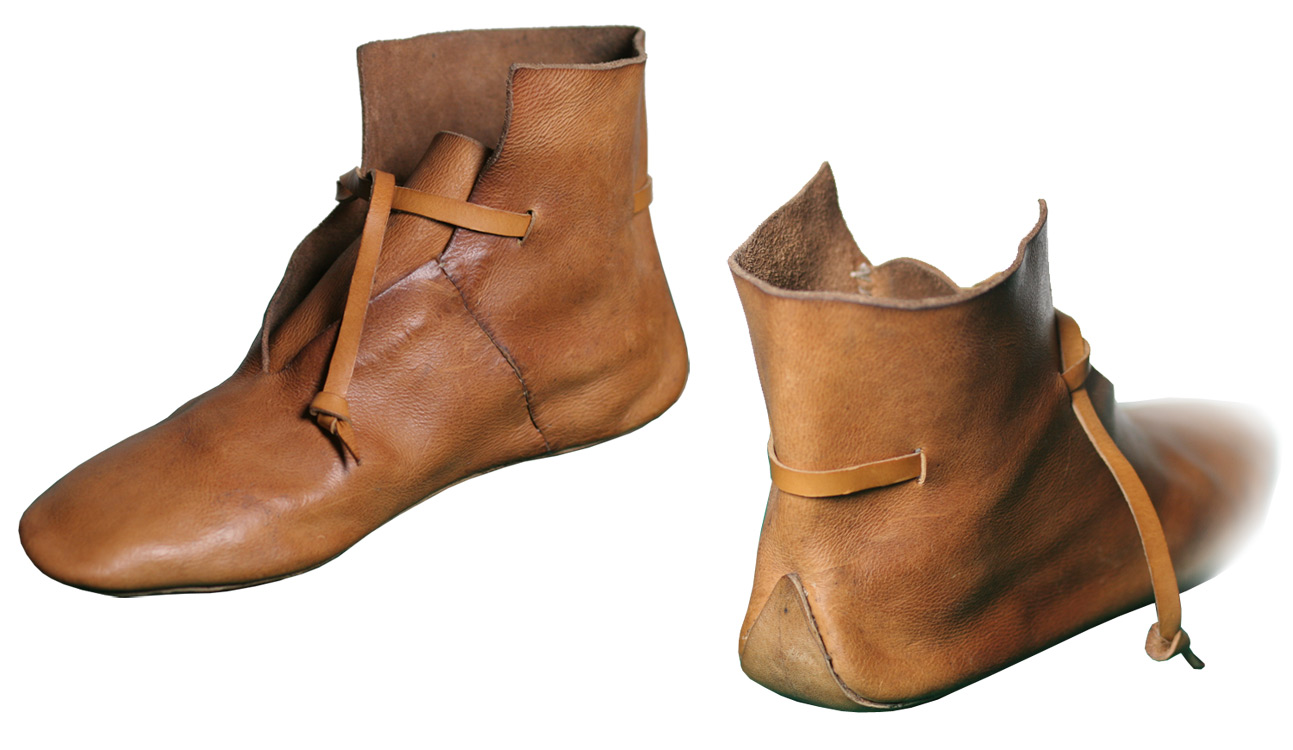
The typical viking shoe was made from two pieces, the upper and the sole. The distictive feature is a triangle shaped heal, which was a feature of dark age footwear up intil about 1150, when rounded heals came into vogue.

Notice the sole is not formed to the foot as is the medieval example at the bottom.

There are two main types of viking shoe. The first and most common is by thonging around the top of the shoe. This can be seen in the Jorvik II on the far right.

The Jorvik I type is closed by a flap crossing over and closing with a button.

The Heddeby shoe is an early type of turn shoe.  This is the least common type found, but could be less costly, but less protective. Any of these types could be worn by our modern Hersir.


A pair of shoes from Medievaldesign.com.

It is always easy to do the wrong thing. If you take the time and effort you will recreate a true vision of the Hersir.

This looks cool, but it's not history:

Friday, July 16, 2010

The first layer

Recreating a Norse persona of the 6th to 8th century is a difficult task. This is the time of Beowulf and not alot of archeological finds have been discovered to support recreating this period. We are left with later remains and hope that they can provide us with a guide to what came before.

"Frome where have you carried
these gold-inlaid shields
these shirts of mail,
masked helms and battle stafts?
I am Hrothgar's messanger and officer.
Never have I seen braver strangers.
I expect youa re here
to find adventure, not asylum.

The brave one answered him,
he of the brave Geats tribe,
hard under his helmet:
"We are Hygelac's table companions.
Beowulf is my name.
I declare to the great lord,
Healfdene's sone, my errand,
if your prince will great us."

In the peom we know that Beowulf and his men wore helmets, mail, and shields inlaid with gold. My last post talked about helmets. This one will discuss the clothing under the armour.

Carolyn Priest-Dorman states in 'An Archaeological Guide to Viking Men's Clothing (1993):

From the Bronze age onward, it seems that the basics of the men's clothing in Scandinavia changed little, consisting of trousers, tunics, coats, and cloaks. While the materials of the garments changed from hide and leather to wool and, ultimately, linen, the cut changed more slowly, if at all. Decoration, on the other hand, seems to have changed quite a bit in the several centuries between Evebo and New Birka.

Iconic evidence in such forms as the Gotlandic picture stones and the Oseberg tapestry suggest that the vikings wore at least two types of leg coverings: a wide, knee-length baggy type and a narrow, full-length, more fitted type.

The smocks (undertunics) worn at Hedeby seem to be of two basic types. Both types share the elements of rounded neckline. rounded armholes for set-in sleeves, and a seperate front and back pannels sewn together at the shoulders (Hagg 1984, 171)

Most were of wool, and some were dyed. Sleeve tapered in width at the lower arm, so that they fit fairly snugly at the wrist, and they could also be cut in more than one peice to achieve a more complicated taper.

At Jorvik in the 8th and tenth centuries, strips of plain tabby-woven silk in bright colors were used to edge overgarments.

The overtunic ould be constructed along the same pattern as the undertunic and made of wool. A richer Hersir would have had a tunic dyed in a bright color with tablet woven strips around the neck and cuffs. There is some evidence the undertunic would be longer than the overtunic, showing a contrasting color at the sleeves and hem.

The young man from a eastern scananavian settlement is wearing a Kafkan overtunic. This variation is typical of the Norse in Russia.The rest of the clothing conforms to what we've been talking about.

Our goal to recreate a Geat from the 8th century is beginning.


Wednesday, July 14, 2010

Helmets


My favorite helm so far is this one from the movie Beowulf and Grendal. The oculars add so much to it. The chain mail drape in the back is great too. This peice is expensive at $275.00. You can find it at Buy the Sword.

It is a heavy peice, made from 14 gauge steel. The hanging mail in the back is rivited, but the attachment rings are butted. I am replacing those rings with waxed thread.
The helmet has a liner, but it is a leather suspention type and not historic. I worked for me, though.
For the SCA you could not use this helmet and I am in the process of working my existing SCA spangenhelm to look similar to this example.

I have a helm from Otto Armoury back in the early 1990s. It is a very simple spangenhelm with a nasal guard. I had padded it with blue camp foam and duct tape, and added a simple 550 cord chinstrap.
My goal is to add eyebrows and nasal detailing from Raymound's Quiet Press, add a leather drape around the back and add a more historic padding and chinstrap. Where it won't have the oculars, it will look similar- which is what I want. I'll post pics of the SCA helm in the following posts.

The Long Journey

Over the many years I have been envolved in various medieval combat games, from SCA to LARPing. During that time I have fallen back into one persona that I have enjoyed the most. This blog is about being a Viking in those various worlds.

First off, what to I mean by being a Viking? Vikings came from the far north - what is today modern Norway, Denmark, Sweden and Finland. The people of Britain usually called them Northmen or Danes - rarely "Vikings". Viking was definitely more of an attitude than a people. Men went "a viking" - that is to trade, raid or settle a different country to the one they were born in.
The Vikings hit the shores of Britain in the late eighth century - giving the monks on Lindisfarne a hard time in 793AD. The campaign of raiding easy targets such as monasteries was to go on for a further 50 years or so.

In 865AD a "Great Army" arrived in the East Anglia which was to leave a trail of devastation throughout the country. This army overran the towns of York, Nottingham and Reading. Their progress south was halted at the battle of Edington in Wiltshire by Alfred the Great in 878AD. Alfred and the Viking King Guthrum arranged to share England between them, drawing a line between the Dee and the Thames to split the land creating the Kingdom of Wessex to the South and the Danelaw in the North. Over a further 50 years the Wessex kings would conquer the Danelaw which would lead to the creation of England. Many battles occurred in this period between the Saxons and the Vikings of the Danelaw.

Things then remained pretty quiet until the 990's when a new army of Vikings started to attack the south coast. Led by men with names such as Olaf Trygvassen, Sven Forkbeard and his son Cnut. The Saxons fought them off for 20 years - but the Vikings demanded more and more silver in exchange for them going away. This was a protection racket on a big scale - more than 100,000 pounds of silver would make their way to Scandinavia in this period. Eventually the Saxons could stand no more and in 1016 England found itself a colony of Denmark under the rule of Cnut. With the death of Cnut's sons the throne reverted to the Saxon kings - there would be attempts at the recovery of the kingdom in 1066, but the Viking age was effectively finished.

I am trying to recreate one of those first Danes who sailed west in 793 AD.

I am using authenticity guides from various sources in order to re-create this look. One of these is The Vikings, a rehistoric group from the UK.

Creating the look for a viking warrior isn't too difficult, as much research has been done. In the picture up above you can see me at a local LARP event, outfitted as a Hersir.

A hersir was a local military commander of a hundred and owed allegiance to a jarl or king. They were also aspiring landowners, and, like the middle class in many feudal societies, supported the kings in their centralization of power. The hersir was often equipped with a conical helmet and a short mail coat. Most would wield an iron sword, mostly augmented with a wooden shield. They were also known to wield one- or even two-handed axes. The hersir would always fight on foot, usually as part of a shield wall formation. Another formation was also used, the Svinfylking, which was a variation to the shield wall but with several wedge like formations pointing towards the enemy creating a zig zag pattern.

My helmet is a recreation from the movie Beowulf and Grendal. My mail coat is rivited mail from Historic Enterprises. Shield and sword are Foam Boffers. The tunic and trousers I made from patterns found on the internet and are reflective of a 7th to 10th century danish bog find. The leggings and boots are LARPish affliction.

In the title picture you can see a better image of the helm. and a padded jacket worn under a tartan cloak. The dagger at my waist is a latex one, as is the axe in my right hand. It's turned just enough so you can not see the blade- but it is there. The sword is worn slung on my back for ease of movement- not typical for the timeperiod.

Well, this is the beginning. Hope to post much in the coming days.

Thorwald Hrodgerson.